


Every football bettor faces the same fundamental question that separates long-term winners from chronic losers: are you betting on outcomes, or are you betting on value? The distinction sounds academic until you realize it explains why some people profit from football betting over years while others bleed money despite occasionally picking winners. Backing favorites does not make you a smart bettor. Neither does finding the occasional upset. What makes you profitable is consistently identifying situations where bookmaker odds underestimate actual probabilities — and that is value betting in its purest form.
The concept is deceptively simple but fiendishly difficult to execute. Value betting means placing wagers only when you believe the true probability of an outcome exceeds what the bookmaker’s odds imply. If you think Manchester United has a 55% chance to win but the odds suggest only 45%, you have found value. The bet might lose — in fact, it will lose about 45% of the time if your assessment is correct — but placing that bet repeatedly puts mathematics on your side.
This guide dives deep into value betting strategy as it applies to football in 2026. We will cover the underlying mathematics, explain how to calculate probabilities, explore where value typically hides in different markets, and build a practical system you can implement immediately. By the end, you will understand not just what value betting is, but how to actually find and exploit it.
Mathematical Principles of Betting Value

What Is a Value Bet?
A value bet occurs when the odds offered by a bookmaker are higher than they should be based on the true probability of the outcome occurring. In simpler terms, you are getting paid more for a bet than the risk justifies. The bookmaker has made a pricing error in your favor, and your job as a value bettor is to identify and exploit these errors before the market corrects them.
Consider a coin flip. Fair odds for heads would be 2.00 (even money), reflecting the 50% probability. If someone offered you 2.20 odds on heads, you would have a value bet because the odds imply only 45.5% probability (100 divided by 2.20) when the true probability is 50%. Place that bet a hundred times, and you would expect to win 50 times at 2.20 odds, generating profit despite no skill being required. Football betting works identically, just with more complex probabilities.
The critical insight is that value is independent of whether the bet wins or loses. A value bet can lose and still have been the correct decision, just as a bad bet can win and still have been a mistake. This mental shift from outcome-focused thinking to process-focused thinking distinguishes professional bettors from amateurs who judge every bet by its result.
Why Bookmakers Are Not Perfect
Bookmakers are sophisticated operations with teams of traders, access to massive data sets, and years of market-making experience. So why do value opportunities exist at all? The answer lies in understanding that bookmakers are running businesses with priorities beyond perfect pricing.
First, bookmakers must offer markets on hundreds of matches simultaneously across dozens of leagues. Their attention gets divided, and pricing quality varies. A Premier League match attracts their best analysts and sharpest lines. A Swedish second division match might receive cursory attention and sloppier odds.
Second, bookmakers respond to betting volume. If recreational money floods in on a popular team, the bookie might shade their line to balance liability rather than to reflect true probability. This creates value on the other side that sharp bettors can exploit.
Third, bookmakers build margins into every market. They are not trying to offer perfectly fair odds — they are trying to profit regardless of outcome. This margin creates inefficiencies because it affects different selections differently. Sometimes the margin gets loaded onto favorites, sometimes onto underdogs, and sometimes unevenly across specific outcomes.
Long-Term vs. Short-Term Thinking
Value betting only works with long-term thinking and sufficient sample size. If you place five value bets and three lose, you cannot conclude the strategy failed. Statistical variance dominates short sample sizes. You need hundreds of bets before you can meaningfully assess whether your value identification is accurate.
This creates psychological challenges that many bettors cannot overcome. Watching a clear value bet lose hurts, especially when you did everything right. The temptation is to abandon the approach or to start questioning your analysis. But questioning after losses and doubling down after wins is exactly backwards. Your process deserves evaluation, but results over small samples tell you almost nothing about process quality.
The successful value bettor embraces variance as the cost of doing business. You will have losing days, losing weeks, even losing months. What matters is whether your edge is real and whether you have the bankroll and discipline to survive the downswings until probability manifests as profit.
Calculating True Probabilities

Building Probability Models
Value betting requires you to estimate probabilities better than bookmakers, at least in specific situations. This sounds impossible given their resources, but remember: you can specialize where they must generalize. A bookmaker pricing 500 matches weekly cannot dedicate the attention to each match that you can dedicate to your chosen few.
The simplest probability model starts with historical baselines. How often do home teams win in this league? How often does a team in this position beat a team in that position? Historical averages provide starting points that you adjust based on match-specific factors.
More sophisticated models incorporate expected goals (xG), form metrics, Elo ratings, and other statistical measures. The 2026 betting landscape offers abundant data through platforms like FBref, Understat, and various paid analytics services. Building even a basic model that combines league position, recent xG performance, home advantage, and head-to-head history can produce probability estimates competitive with bookmaker assessments.
The key is consistency and iteration. Your model does not need to be perfect; it needs to be systematically better than bookmaker odds in your chosen niche. Document your methodology, track your predictions against outcomes, and refine over time.
Using Historical Data
Historical data forms the backbone of probability estimation, but using it correctly requires understanding its limitations. Past results indicate tendencies, not certainties. A team that wins 70% of home matches against similar opponents might win anywhere from 50% to 90% in any given season depending on countless variables.
Start with multi-season samples where possible to smooth out single-season anomalies. A team’s performance over three years tells you more than their results this season alone, although recent form obviously matters and should weight more heavily in your analysis.
Segment historical data to match your bet. Home performance against away performance. Performance against top-half versus bottom-half opponents. Performance in matches with similar stakes. The more precisely your historical comparison matches the current situation, the more useful the baseline probability.
Beware of small sample sizes creating false precision. If a team has played five matches against a specific opponent and won four, that 80% win rate comes with massive confidence intervals. Supplement sparse head-to-head records with broader categorical data.
Adjusting for Current Form
Historical baselines need adjustment for current circumstances. A team that historically wins 60% of home matches might deserve higher probability if they are in peak form, or lower if key players are injured.
Recent xG performance is particularly valuable for form assessment because it captures underlying performance quality better than results. A team might have lost their last three matches despite dominating xG, suggesting negative variance that will likely correct. Conversely, a winning streak built on xG underperformance should trigger skepticism about sustainability.
Injuries and suspensions require contextual understanding. Losing a star striker obviously matters, but how much depends on the backup options and the opponent’s defensive profile. Losing a key midfielder might matter more against opponents who dominate possession. Context determines adjustment magnitude.
Tactical matchups also influence probability adjustment. Some teams stylistically struggle against specific opponents regardless of overall quality. If you follow your target leagues closely enough to understand these dynamics, you can make adjustments that purely statistical models miss.
Incorporating Team News
Team news often provides your greatest edge over bookmakers because markets respond slowly to late-breaking information. Starting lineup announcements, which typically arrive 60-75 minutes before kickoff (75 minutes in the Premier League since 2024/25), can significantly shift true probabilities while odds adjust with lag.
Develop reliable information sources for your target leagues. Official club channels, trusted journalists, and aggregator accounts on social media can give you early signals about rotation, injuries, or tactical surprises. If you know a key player will be rested before the betting market reflects it, you have genuine informational edge.
The challenge is that late information requires fast action. You need accounts funded and ready at multiple bookmakers, plus the discipline to make quick decisions under time pressure. Many recreational bettors cannot execute pre-match bets in this window, which is precisely why value exists there.
Comparing Odds Across Bookmakers
The Importance of Line Shopping
Value betting becomes dramatically easier when you access the best available odds rather than accepting whatever one bookmaker offers. A selection might be 1.85 at one book and 2.00 at another — the difference between negative expected value and positive expected value if your true probability estimate is around 52%.
This practice, called line shopping, requires maintaining accounts at multiple bookmakers. Serious bettors often have accounts at ten or more operators, allowing them to always bet at the highest available price for their selections. The effort of managing multiple accounts pays for itself through thousands of small edge improvements compounding over time.
In 2026, odds comparison becomes easier through aggregator sites that display real-time prices across major bookmakers. These tools should be open alongside your match analysis, not consulted as an afterthought. The best price often sits at a bookmaker you do not normally use, and finding it requires active searching.
Timing Your Bets
Odds move constantly as money flows into markets, news emerges, and bookmakers adjust their positions. Understanding when to bet can matter as much as what to bet.
Early markets, published days before matches, often contain value because bookmakers have less information and face less sharp money pressure. As kickoff approaches, odds typically sharpen as professional bettors identify and eliminate mispricings. Sometimes your value exists early and evaporates by matchday.
Conversely, late markets can offer value when news breaks that bookmakers cannot fully incorporate before kickoff. The 60-90 minute window between team announcements and match start is notoriously volatile and potentially profitable for prepared bettors.
Track how odds move on your selections after you bet. If you consistently bet early and see odds drift in your favor before kickoff, that suggests your analysis identifies value that the market eventually recognizes. If odds consistently move against you, the market may know something you do not.
Soft vs. Sharp Bookmakers
Not all bookmakers price markets equally. “Soft” bookmakers cater to recreational bettors with generous promotions, limited markets, and less sophisticated pricing. “Sharp” bookmakers target professional volume with tight margins, deep liquidity, and accurate odds.
Value bettors often find more opportunity at soft books because their looser pricing creates more frequent mispricings. However, soft bookmakers also restrict or ban winning accounts more aggressively, creating a constant dance between exploiting value and maintaining account access.
Sharp bookmakers offer thinner margins but also serve as benchmarks for fair pricing. If your selection looks like value against sharp lines, your edge is almost certainly real. If it only looks like value against a single soft bookmaker, proceed with more caution.
Finding Value in Different Markets

1X2 Market Value Spots
The traditional match result market is heavily scrutinized, making pure value harder to find than in less popular markets. However, opportunities exist, particularly around specific price points.
Moderate underdogs in the 3.00-5.00 range often contain value because recreational bettors systematically underestimate upset probability. A team priced at 4.00 needs to win only 25% of the time to break even, yet many such teams win 28-32% of matches in their league contexts. The public’s favorite bias creates systematic underdog value.
Heavy favorites below 1.40 are typically poor value because the margin gets loaded onto the low-odds selection. Bookmakers know recreational bettors love backing big teams at short prices, so they shade those odds accordingly. Even when the favorite deserves to win 70% of the time, the odds might imply 75%, destroying value.
Draw betting is perpetually underrated by casual bettors who find draws boring. Yet draws occur in roughly 26% of matches across major leagues, and odds frequently imply lower probability than this baseline suggests.
Goals Markets Opportunities
Over/under goals markets respond to narrative and recent history in ways that create systematic mispricings. When a team has played several high-scoring matches, odds on overs shorten even if underlying xG suggests the goal output was unsustainably lucky. Conversely, a string of low-scoring results can make unders expensive when the underlying attacking quality predicts regression upward.
BTTS markets similarly overweight recent results. A team that has kept three consecutive clean sheets sees BTTS No prices drop even if their defensive xG suggests those clean sheets were fortunate. Identifying discrepancies between actual results and underlying process creates value.
Goal line selection matters enormously. The standard 2.5 line is the most efficient because it attracts the most attention and sharpest pricing. Alternative lines like 1.5, 3.5, or Asian goal lines (2.25, 2.75) often contain more value because they receive less market scrutiny.
Asian Handicap Value
Asian handicap markets attract professional money, which makes them sharper but also creates different value dynamics. The absence of the draw removes a variable that recreational bettors mishandle, making Asian handicap pricing more efficient overall.
Value in handicap markets often comes from overreaction to match importance or reputation. A big team facing a relegation battle opponent might see their handicap line inflated by recreational money that always backs prestigious sides, even when the match context suggests a narrow, grinding encounter.
Quarter-goal lines (-0.25, -0.75, etc.) require more sophisticated analysis but can offer edge precisely because casual bettors find them confusing. If you genuinely understand how these lines work, you operate in less crowded space than the standard full-goal or half-goal markets.
Player Prop Value
Goalscorer markets and player props contain significant value because individual player performance is harder for bookmakers to model than team outcomes. A striker’s likelihood of scoring depends on expected minutes, quality of chances, penalty-taking status, form, and opposition defensive profile — multiple factors that compound modeling complexity.
Anytime goalscorer markets specifically reward detailed player analysis. Understanding who takes penalties, who arrives late in the box, and who operates in positions that generate high-quality chances can reveal mispricings that team-level analysis misses.
Emerging players and those newly installed as primary scorers often carry value because bookmakers adjust historical pricing slowly. If a young forward has earned a starting role but his odds still reflect backup-level expectations, that lag creates opportunity.
Practical Value Betting System
Step-by-Step Process
Implementing value betting requires systematic workflow, not inspired hunches. Begin each betting session with your target matches identified based on league specialization and schedule. Then move through a consistent process.
First, conduct match analysis: form, xG, injuries, tactical matchups, team news, and any special circumstances. Document your assessment of the key factors that will influence the outcome.
Second, estimate probabilities for your target markets. Write down your percentage estimates before looking at odds. This prevents anchoring, where seeing bookmaker prices unconsciously influences your assessment.
Third, convert your probabilities to fair odds (100 divided by probability percentage) and compare against available bookmaker odds. Calculate expected value for any selections where odds exceed your fair price.
Fourth, validate your edge by checking multiple bookmakers. If only one soft book offers value while sharp lines suggest your probability is wrong, reconsider. If value appears across multiple books, your edge is more likely genuine.
Fifth, place your bet at the best available odds, document the selection, and move to the next opportunity.
Record-Keeping Methods
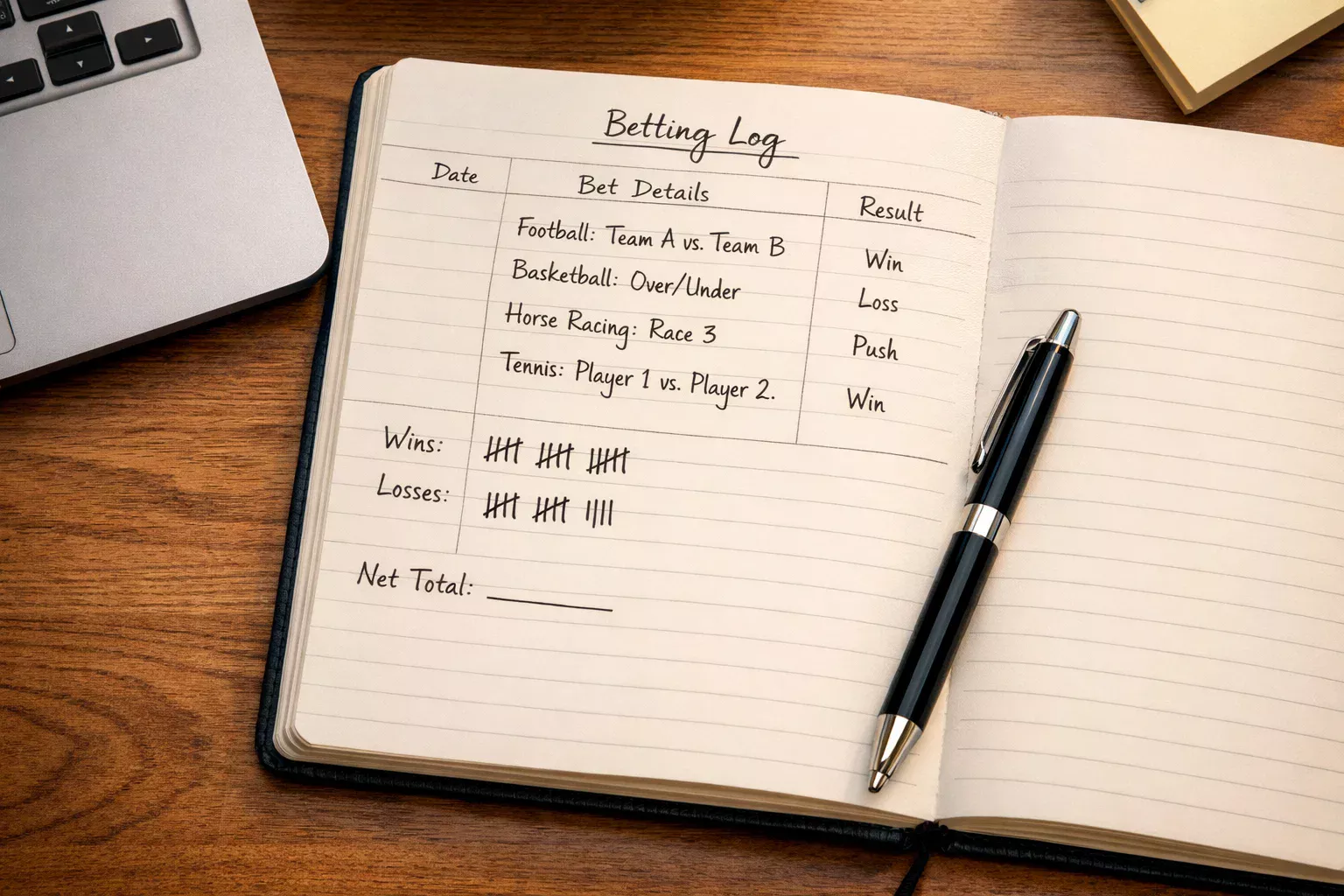
Detailed record-keeping separates serious value bettors from hobbyists. Every bet should be logged with: date, match, selection, your estimated probability, odds taken, stake, and outcome. Additional fields might include bookmaker used, time of bet, and notes on your reasoning.
Spreadsheets work well for most bettors, though dedicated betting tracker software offers features like automatic profit/loss calculation and performance visualization. The format matters less than consistency — every bet recorded with complete information.
Reviewing records periodically reveals patterns in your betting. Which markets produce profit? Which leagues? What probability ranges? Are you finding more value at specific odds levels? This analysis drives continuous improvement.
Tracking Your Edge
The ultimate test of value betting is long-term return on investment (ROI) and profit relative to expected value. If you consistently identify positive EV situations, your actual returns should eventually approximate your expected returns, though variance means convergence requires hundreds or thousands of bets.
Track your closing line value — the difference between odds you bet and odds at kickoff. If you consistently bet at better odds than the market closes at, you are capturing genuine value even if short-term results fluctuate. Closing line value is arguably the best measure of betting skill because it reflects market-validated edge rather than variance-infected results.
Be honest about your results. Selective memory that emphasizes winners and forgets losers is human nature but fatal to improvement. Your records tell the truth; consult them regularly and believe what they show you.
When to Bet and When to Pass
Value betting requires patience to wait for genuine opportunities rather than forcing action. Most matches will not offer value in your areas of expertise. Accept this and be willing to have days or even weeks without placing a single bet.
The discipline to pass on marginal situations protects your bankroll for clear opportunities. A selection with 1% edge is mathematically worth betting but provides so little margin for estimation error that negative results become likely. Selections with 5-10% edge or higher justify more confidence and larger stakes.
Trust your process over your desire for action. Recreational bettors need the excitement of money at risk. Professional bettors need profitable expectations. These are often mutually exclusive on any given day.
Advanced Value Concepts
Closing Line Value
Closing line value (CLV) measures whether you bet at better odds than the market eventually settles on. If you bet Team A at 2.50 and they close at 2.30, you captured closing line value — the market moved in your favor, confirming your early edge identification.
CLV matters because it removes short-term variance from edge measurement. Results fluctuate unpredictably over small samples, but consistently beating closing lines indicates you are identifying value that the broader market recognizes by kickoff. Studies suggest CLV correlates strongly with long-term profitability.
Track your CLV religiously. If you consistently see negative CLV — betting at worse odds than close — your timing or analysis needs work. Consistent positive CLV confirms your process even through losing stretches.
Market Efficiency
Different markets exist along an efficiency spectrum. The most liquid markets (Premier League 1X2, for example) attract massive volume and sharp money, making value scarce and fleeting. Less liquid markets (lower leagues, obscure props) receive less attention and contain more persistent value.
Your strategy should account for efficiency levels. In highly efficient markets, value windows close quickly and require faster execution. In less efficient markets, value might persist for hours or even days, allowing more deliberate analysis.
Efficiency also affects bet sizing. When market evidence strongly supports your edge (sharp lines confirm your value), larger stakes are justified. When you are operating in inefficient markets where validation is impossible, conservative sizing protects against estimation errors.
Arbitrage Basics
Arbitrage betting involves exploiting odds discrepancies between bookmakers to guarantee profit regardless of outcome. If one bookmaker offers 2.20 on Team A and another offers 2.00 on Team B in a two-way market, you can back both sides with appropriate stake proportions and profit regardless of result.
Pure arbitrage requires significant capital and fast execution because discrepancies close quickly. Many serious bettors combine value betting with selective arbitrage, taking guaranteed profits when they appear while otherwise pursuing positive expected value opportunities.
Bookmakers actively identify and restrict arbitrage bettors, making this strategy difficult to sustain long-term at meaningful volume. However, understanding arbitrage mechanics helps you recognize when odds discrepancies exist and why markets move.
Common Value Betting Mistakes

Overestimating Your Edge
The most dangerous mistake in value betting is overconfidence in your probability estimates. If you think a team has 45% chance to win but they actually have 38%, you will perceive value that does not exist and lose money chasing phantom edge.
Combat this tendency by tracking results against predictions and honestly assessing calibration. Are outcomes matching your probability estimates across large samples? If your 50% predictions actually win only 42% of the time, your estimation process needs recalibration.
Seek disconfirming evidence rather than confirmation. When you identify apparent value, ask what you might be missing. What does the market know that you do not? Why are professional traders not exploiting this edge? Sometimes you genuinely have information they lack. Sometimes you are simply wrong.
Ignoring Variance
Variance is not a vague concept but a mathematically predictable reality of probability-based betting. Even with 5% edge on every bet, you face significant probability of substantial drawdowns over hundreds of wagers. Treating these inevitable losing runs as evidence of strategy failure leads to constant system-switching that never allows any approach to prove itself.
Calculate expected variance for your betting style. At typical odds and stake sizes, how much downswing should you expect over your projected betting volume? If the answer exceeds your psychological or bankroll tolerance, either reduce stakes or increase bankroll before starting.
Poor Bankroll Allocation
Betting too large relative to your edge magnifies variance and risks ruin during inevitable downswings. Most experts recommend risking 1-3% of bankroll per bet for typical recreational edges. Higher edges justify higher stakes, but aggressive sizing requires high confidence in edge estimation.
Kelly criterion offers mathematical framework for optimal bet sizing based on edge and odds, but full Kelly is too aggressive for real-world conditions with uncertain edge estimates. Quarter-Kelly or half-Kelly provides most of the long-term growth with much better risk management.
Never let enthusiasm for a particular bet drive stake decisions. Your stake should reflect edge magnitude and bankroll percentage, not how confident you feel in the moment.
Emotional Interference
Betting psychology destroys mathematically sound strategies when bettors cannot maintain discipline through losing periods. Chasing losses with larger bets, abandoning winning approaches after variance-driven drawdowns, and letting excitement override analysis all represent emotional interference that undermines value betting.
Develop pre-commitment strategies to maintain discipline. Set maximum daily loss limits. Review records before betting sessions to ground decisions in data rather than feeling. Build in cooling-off periods after significant losses.
Recognize that emotional stability is a skill that develops with experience. Your first year of value betting will likely involve psychological mistakes that hurt performance. Learn from them rather than concluding the strategy cannot work.
The Path to Profitability
Value betting offers a genuine path to football betting profitability, but that path requires patience, discipline, and continuous learning. You will not become profitable overnight. You will not win every week. You will experience losing months that make you question everything. The bettors who succeed are those who trust verified process over short-term results and maintain discipline when human psychology screams to change course.
Start small with stakes you can comfortably lose while learning. Specialize in specific leagues and markets rather than spreading attention thin. Build your probability estimation skills through deliberate practice and honest result tracking. Treat betting as a long-term investment requiring statistical edge rather than a gambling thrill requiring luck.
The 2026 football betting market offers real opportunity for sophisticated bettors. Bookmakers are imperfect, recreational money creates systematic biases, and information edges exist for those willing to work. Whether you achieve profitability depends entirely on your commitment to the process that makes value betting work.
